Understanding Pearls: The Distinction Between Precious and Semi-Precious Varieties
Pearls have captivated humanity for millennia, prized for their luminous beauty, rarity, and organic origin. Historically, pearls were classified into two main categories: precious and semi-precious. Although the gem trade has largely moved away from these terms in favor of more specific descriptors (such as saltwater vs. freshwater, natural vs. cultured, and naming by producing mollusk), the traditional distinction remains relevant for collectors, jewelers, and enthusiasts. This article examines the key differences between precious and semi-precious pearls, focusing on origin, rarity, value, appearance, and market perception.
1. Definition and Historical Context
- Precious pearls traditionally refer to natural saltwater pearls produced by specific marine mollusks, primarily the Pinctada species (e.g., Pinctada maxima, Pinctada margaritifera, and Pinctada mertensi). The most iconic examples are Persian Gulf (Basra), Australian South Sea, and Tahitian black pearls (when natural).
- Semi-precious pearls historically encompass all other pearls, including natural freshwater pearls and, later, most cultured pearls (both saltwater and freshwater).
The terms “precious” and “semi-precious” originated in the early 20th century when natural saltwater pearls commanded astronomical prices—often exceeding diamonds of comparable size—while freshwater and early cultured pearls were considerably more accessible.
2. Origin and Formation
- Precious pearls (traditional natural saltwater)
Form exclusively in saltwater oysters of the Pinctada genus. Natural examples are extraordinarily rare because they require a wild oyster to be irritated by a parasite or foreign object and then survive years without human intervention. - Semi-precious pearls
Include natural and cultured freshwater pearls (primarily from Hyriopsis mussels in China) and cultured saltwater pearls (Akoya, South Sea, and Tahitian). Culturing involves deliberate human nucleation, dramatically increasing supply and consistency.
3. Rarity and Availability
- Natural precious saltwater pearls are among the rarest gems on Earth. Before widespread culturing, divers harvested millions of oysters to yield only a few high-quality natural pearls. Today, virtually all “precious” pearls on the market (South Sea and Tahitian) are cultured, though still produced in limited quantities.
- Semi-precious cultured Akoya and freshwater pearls are produced in the hundreds of millions annually, making them widely available and affordable.
4. Size, Luster, and Quality Characteristics
| Characteristic | Precious Pearls (esp. South Sea & Tahitian) | Semi-Precious Pearls (Akoya & Freshwater) |
|---|---|---|
| Typical size | 9–20+ mm | 5–11 mm (freshwater now reaching 13–16 mm in premium lines) |
| Luster | Very high to exceptional (mirror-like) | Good to very high |
| Surface | Usually very clean | More blemishes tolerated in lower grades |
| Shape | Round is common but drops and baroques prized | High percentage of near-round or off-round |
| Nacre thickness | Very thick (2–6 mm) | Thinner in Akoya (0.3–1 mm); variable in freshwater |
| Color range | White, golden, and black with overtones | Predominantly white, cream, pastel, and multicolored |
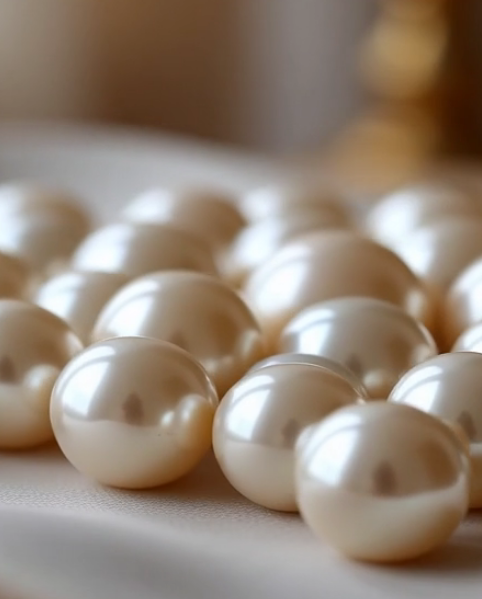
South Sea and Tahitian cultured pearls are still regarded as the pinnacle of pearl quality because of their naturally thick nacre and intense orient (iridescence).
5. Economic Value
- Natural precious pearls: Can exceed $100,000 per pearl for historic strands (e.g., La Peregrina or Baroda necklace pearls).
- Cult-tier cultured South Sea strands: $10,000–$200,000+
- Top-quality Tahitian strands: $5,000–$100,000
- Fine Akoya strands: $1,000–$15,000
- High-end freshwater strands: $200–$5,000
Even within cultured pearls, South Sea and Tahitian maintain significantly higher value per millimeter than Akoya or freshwater due to longer cultivation periods (2–4 years vs. 6–24 months) and lower survival rates.
6. Modern Terminology and Industry Shift
Since the 1990s, authoritative bodies such as the Gemological Institute of America (GIA) and the American Gem Trade Association have discouraged the terms “precious” and “semi-precious” for pearls (and most colored gems) because they are misleading. Today, professionals classify pearls by:
- Environment: Saltwater or freshwater
- Mollusk species: Akoya, South Sea, Tahitian, Freshwater (Hyriopsis, etc.)
- Cultivation status: Natural or cultured
- Specific trade names: Hanadama Akoya, Golden South Sea, Peacock Tahitian, Edison, etc.
Nevertheless, many jewelers and auction houses still use “precious” informally to denote South Sea and Tahitian cultured pearls and “semi-precious” for Akoya and most freshwater.
Conclusion
The traditional distinction between precious and semi-precious pearls reflects historical rarity and economic reality more than any intrinsic material difference. Natural saltwater pearls of the Pinctada oysters were once the exclusive domain of royalty and the ultra-wealthy; today, their cultured counterparts—South Sea and Tahitian—retain the highest prestige and price, while Akoya and freshwater cultured pearls offer exceptional beauty at more accessible levels.
When purchasing pearls, focus on the universal grading factors—size, shape, luster, surface quality, nacre thickness, and color—rather than outdated labels. A superb freshwater or Akoya pearl can easily outshine a mediocre South Sea specimen, proving that, in the modern pearl world, quality transcends historical classification.